Meta AI has created an AI agent designed to capture and preserve specialist knowledge within organizations. This agent operates as a secondary expert, providing readily available and shareable information for anyone within the organization. The core innovation lies in a two-layer architecture: a structured knowledge base and a self-improvement loop that incorporates expert feedback.
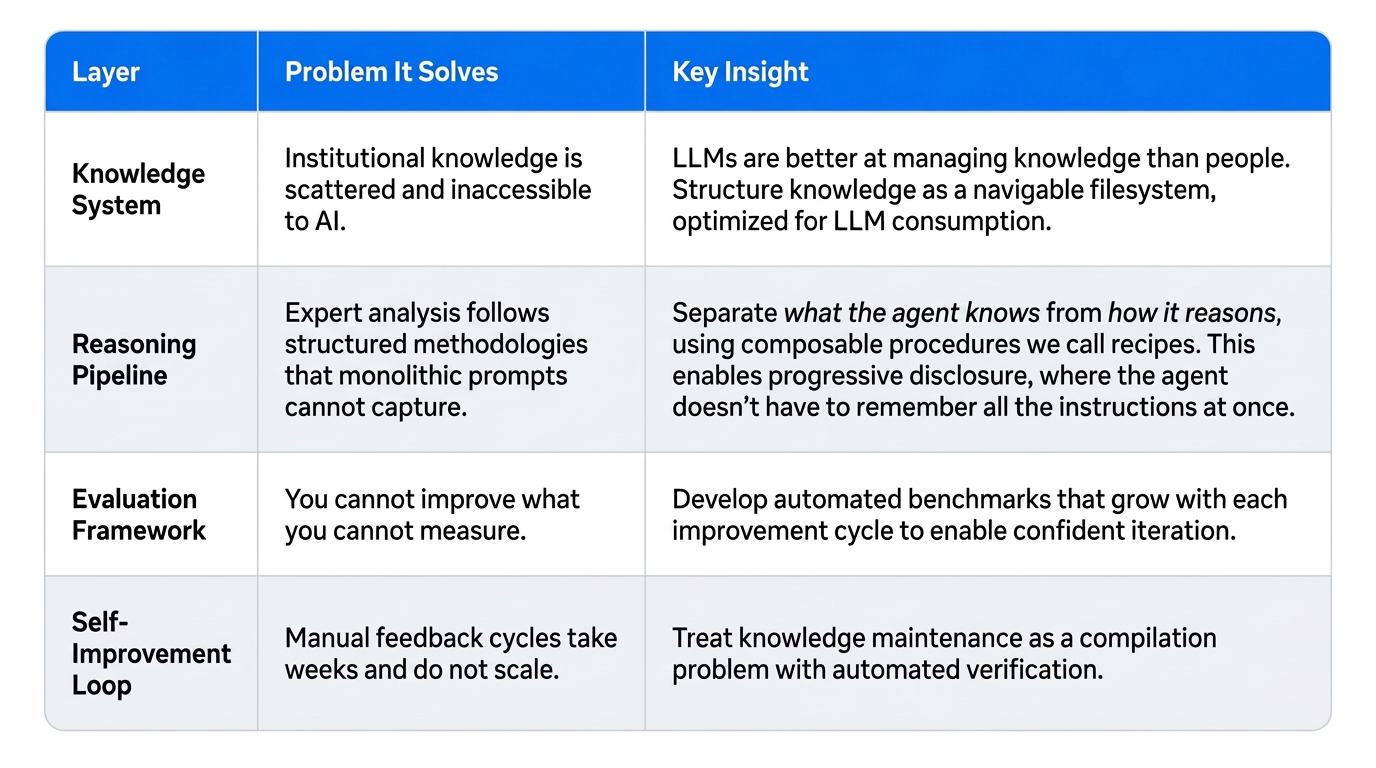
The system separates the agent’s knowledge from its reasoning processes. A self-improvement loop compiles expert corrections into verified updates, creating permanent institutional memory without requiring model retraining. This approach addresses a common challenge for large organizations where valuable specialist knowledge resides primarily in the minds of experts and isn’t consistently documented. The design generalizes to other domains governed by retrievable text rather than model weights.
The system consists of four layers, each addressing a distinct problem. The knowledge system utilizes a file structure enabling automated editing. The reasoning layer’s explicit procedures allow for tractable failure attribution. An evaluation framework governs every change, and the improvement loop feeds back into both knowledge and reasoning. The architecture relies on interconnected components, and any single layer’s failure impacts the overall system’s performance.
This approach builds upon existing research, mirroring Andrej Karpathy’s LLM Wiki and Google’s Open Knowledge Format, which emphasize pre-extracted, explicitly structured knowledge. The system utilizes position files, taxonomy and vocabulary files, routing indexes, and gateway files to organize over 200 files into a strict taxonomy. These files define authoritative organizational stances, maintain a consistent glossary of terms, determine relevant files based on input characteristics, and prevent the agent from applying specialized knowledge inappropriately.
By codifying institutional intelligence, this agent aims to reduce the time experts spend answering routine questions, allowing them to focus on complex, ambiguous work. The system’s design facilitates knowledge sharing and preservation, contributing to greater organizational consistency and risk reduction. Source: https://engineering.fb.com/2026/09/02/ml-applications/organizational-second-brain-ai-learns-from-experts/