Significant Performance Gains
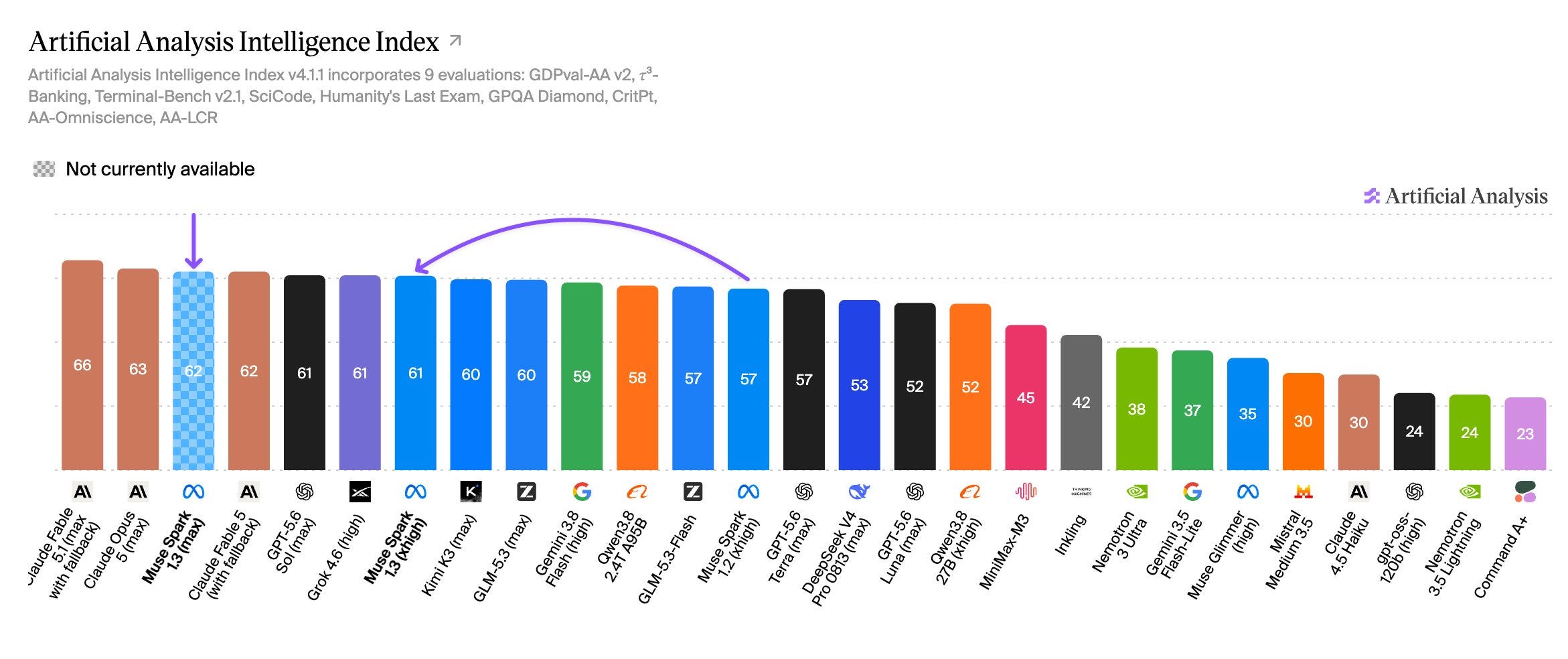
Muse Spark 1.3 has achieved performance levels comparable to leading models like GPT-5.6-Sol and Anthropic’s Opus, according to AAII. This represents a substantial jump in capabilities, particularly in coding and agentic tasks. The release is being offered at a training cost that is over 90% less than comparable models.
Open-Weights and API Access
The model is being released as open weights, and is available through a Muse Code and API. This accessibility is a key component of Meta Superintelligence’s strategy, aiming to accelerate development and experimentation within the AI community.
Pricing and Training
The pricing model for Muse Spark 1.3 is notably cheaper, with an option to opt in to training offering a 90%+ discount compared to traditional model training. This reduced cost is a critical factor in enabling widespread adoption and experimentation.
Stanford Curriculum Shift
Alongside the model release, Stanford is formalizing AI-native software engineering as a discipline. The curriculum reset focuses heavily on agent skills, context engineering, and agent-ready codebase design, incorporating elements like parallel background agents and software factories. This shift reflects a move towards systems-oriented agent engineering, rather than simply relying on prompt engineering.
Inference and Serving Updates
Recent developments in inference infrastructure continue to focus on real-time multimodal workloads. Photon 2.1 now supports NVIDIA B200 and text-to-speech models, while Baseten offers hosted availability of GLM-5.3 Fast, emphasizing higher throughput and real-time deployment.
Source: https://www.latent.space/p/ainews-muse-spark-13-matches-gpt