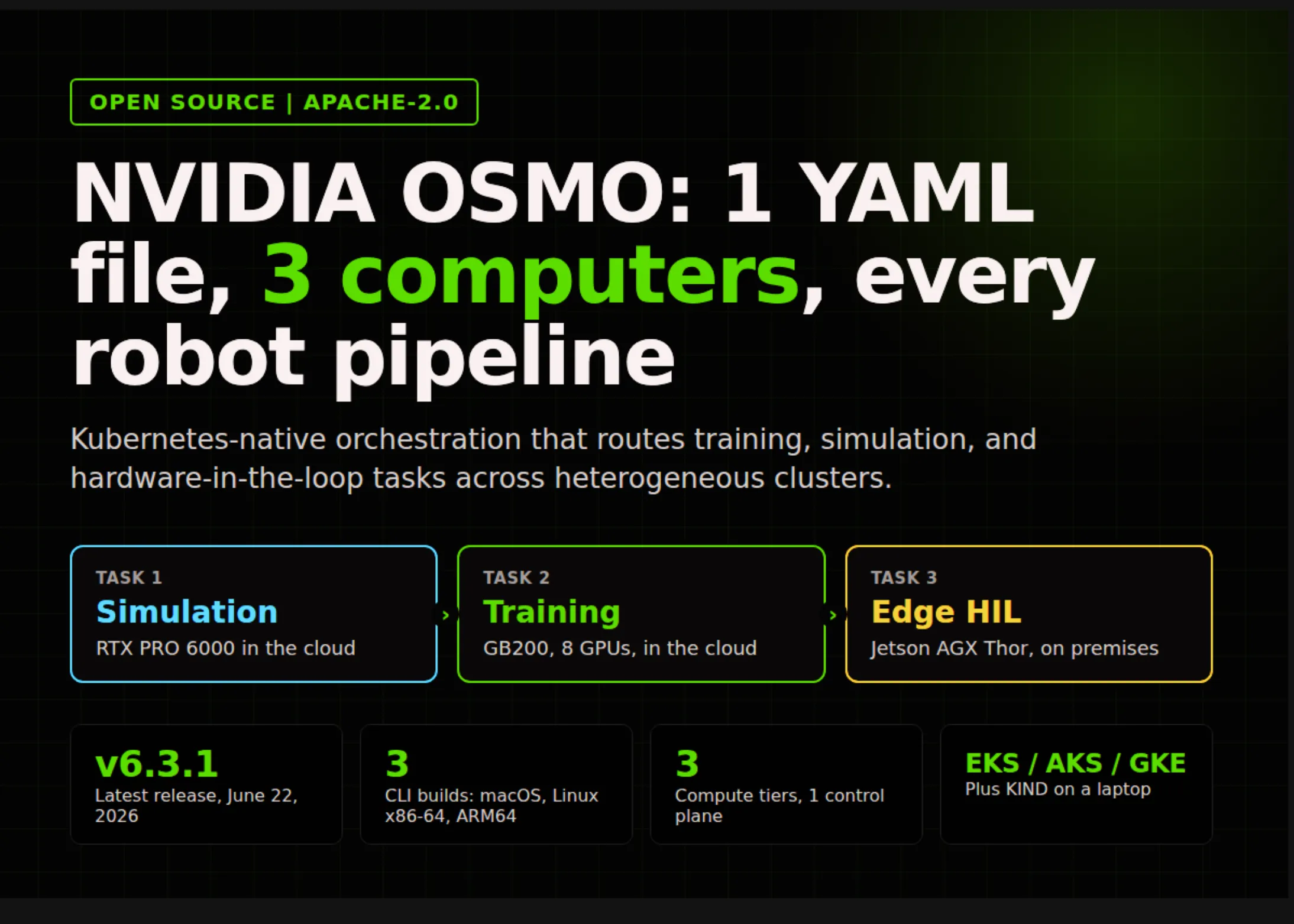
NVIDIA’s OSMO addresses the fragmented workflow challenges common in robotics development. Traditionally, developers manage separate clusters for training, simulation, and deployment, leading to complex handoffs and increased operational overhead. OSMO provides a unified control plane, enabling a team to describe the entire pipeline in a single YAML file and execute it across these tiers without requiring manual infrastructure code modifications.
The system utilizes Apache-2.0 licensing and ships with Helm charts and containers on NGC, facilitating easy deployment. OSMO supports various Kubernetes environments, including EKS, AKS, GKE, and on-premise installations. The initial release, version 6.3.1, includes features like multi-provider deploy-k8s.sh for provisioning on Azure AKS, AWS EKS, and microk8s, alongside storage wiring for MinIO, Azure Blob, and AWS S3.
Key components include the NVIDIA KAI Scheduler, which incorporates NVLink topology-aware placement for multi-GPU tasks, and configurable timeouts per group to prevent cascading failures. The system supports content-addressable datasets with deduplication, potentially reducing storage needs by 10 to 100x. The project integrates with Claude Code, OpenAI Codex, and Cursor, enabling coding agents to manage and debug pipelines. Version 6.3.0 added a live progress bar for the rsync download.
OSMO has been battle-tested on GR00T, Isaac Lab, Isaac Sim, and Isaac ROS. The project’s architecture is designed for portability and scalability, with support for various cloud providers and on-premise deployments. The system’s YAML-based configuration allows for seamless transitions between environments. Source: https://www.marktechpost.com/2026/09/14/nvidia-open-sources-osmo-one-yaml-orchestrates-physical-ai-training-simulation-and-robot-testing/