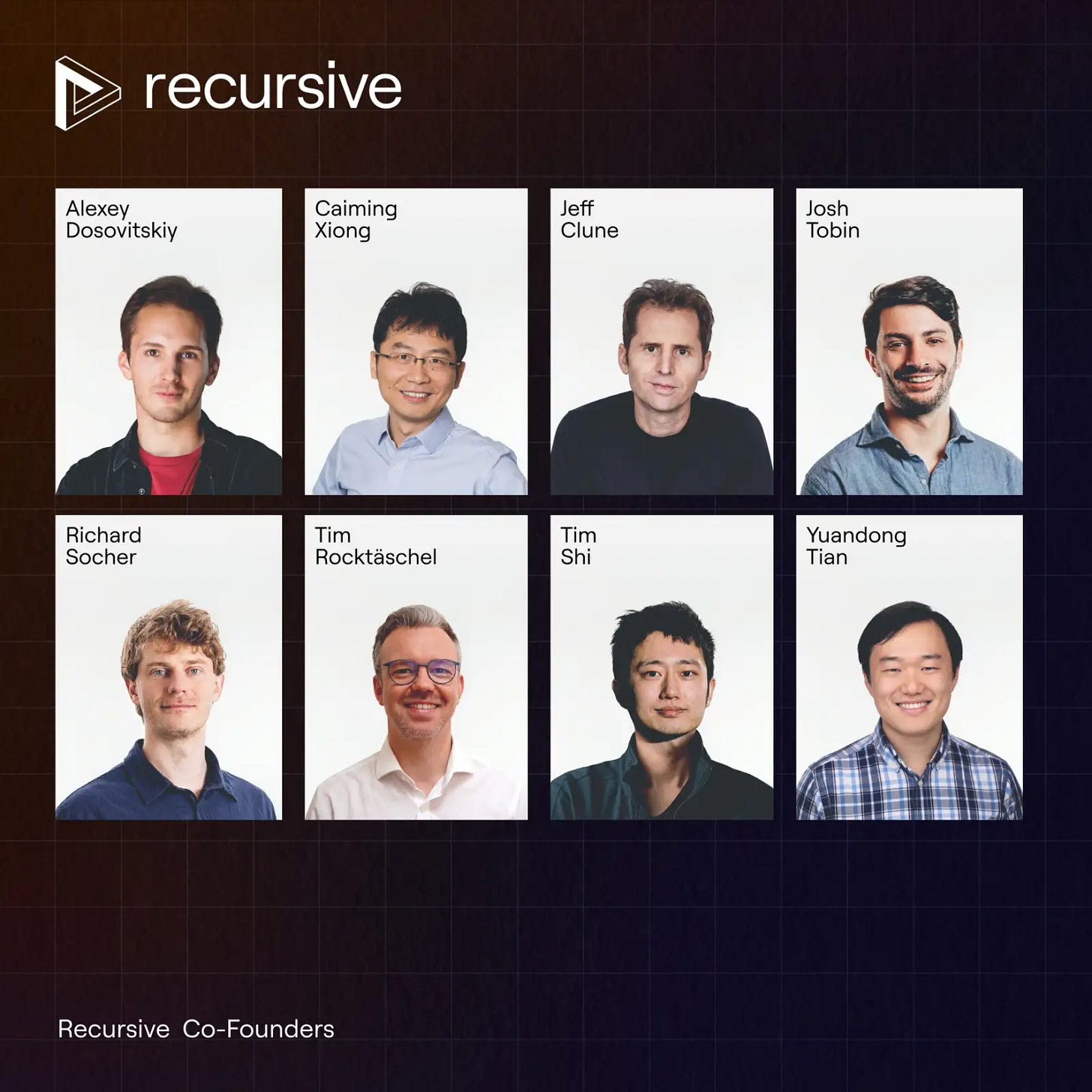
Richard Socher, CEO of You.com and now founder of Recursive, is pursuing a novel approach to AI development: creating an AI system capable of automating the research process. Recursive has raised a $4.65 billion seed round to build this system, which has already demonstrated impressive results. Initial benchmarks show the system outperformed humans and their agents on optimization tasks in less than two days, alongside improvements discovered in NVIDIA GPU kernels without requiring dedicated CUDA expertise. This suggests a potential pathway to compressing years of research into weeks.
The core of Recursive’s vision is the "Eureka Machine," a superintelligence designed to improve the invention process itself. The team is exploring techniques like open-endedness and evolutionary approaches, drawing inspiration from the AI Economist and simulations of entire economies. They are investigating whether current LLM paradigms are sufficient and are less bullish on world models. The company’s early work includes NanoChat, NanoGPT, and GPU kernel optimization, highlighting a focus on efficient compute and hardware utilization.
Recursive’s near-term efforts are centered on applying self-improving AI to AI research, leveraging agent infrastructure built around harness optimization, sandboxing, and web search. This strategy is informed by concerns around reward hacking and the difficulty of designing objective goals for increasingly intelligent AI systems. The team is also examining the potential for open-source AI to serve as a geopolitical soft power and is actively researching the theoretical upper bounds of intelligence across various domains, including vision, communication, and computation.
The company’s long-term plan involves applying this technology to science, with a focus on areas like energy, materials, and biology. They are investigating the constraints on AI takeoff, including compute, hardware, and economic factors. Recursive’s early results and strategic direction indicate a significant investment in understanding and mitigating the risks associated with increasingly capable AI.