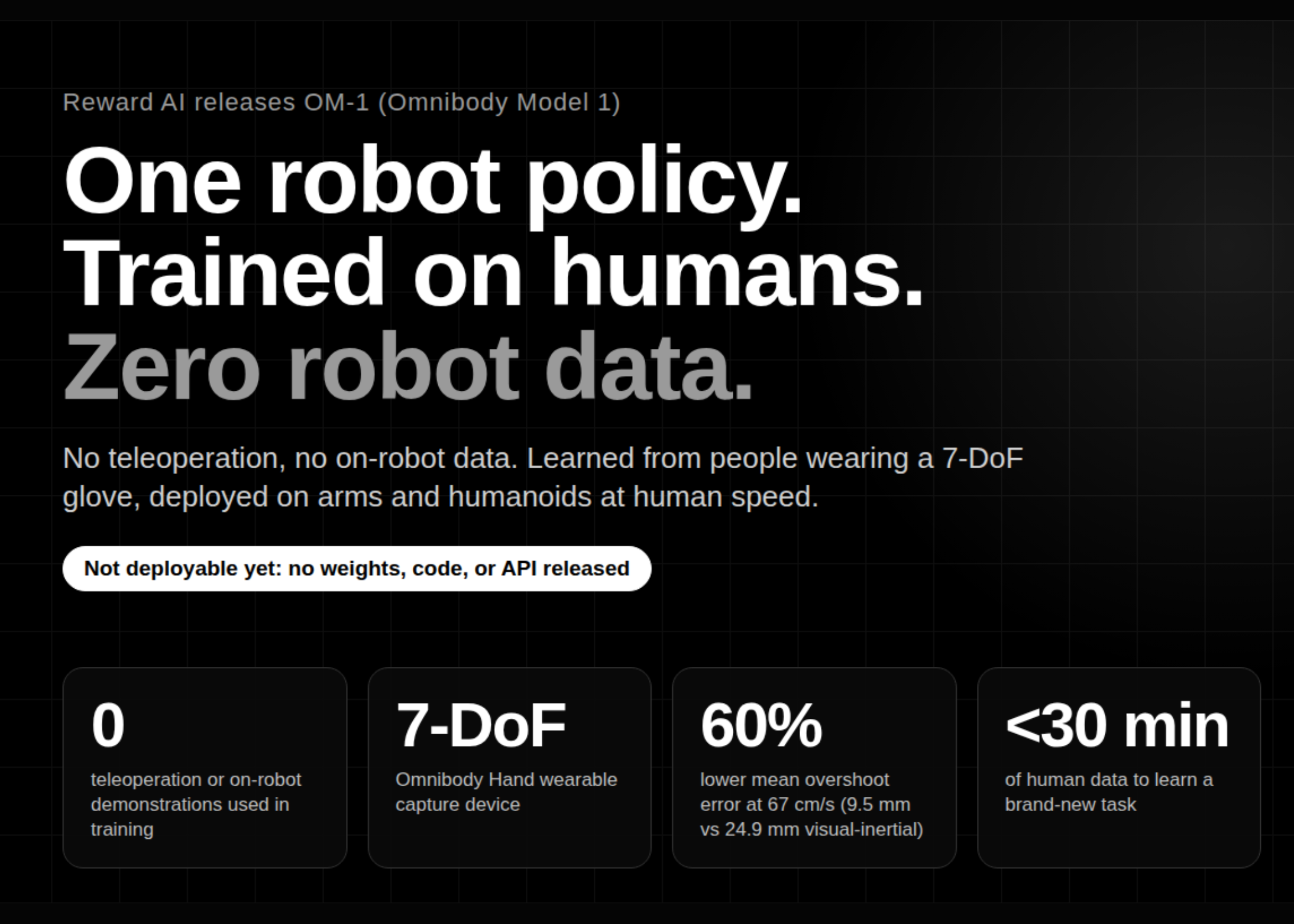
Reward AI’s OM-1 represents a significant shift in robotics policy development. Unlike traditional methods that rely on robot-collected data or teleoperation, OM-1 is trained solely on data captured from a seven-degree-of-freedom sensorized glove worn by a human. This approach, termed ‘One Model, One Data Interface, Any Body,’ aims to bypass the limitations of embodied training. The system’s core innovation centers around capturing human motion at high frequency, incorporating tactile sensing, proximity detection, and in-hand visual data.
The glove’s performance was evaluated through electromagnetic tracking, achieving a 60% reduction in overshoot error compared to visual-inertial tracking at 67 cm/s. This improvement highlights the value of high-fidelity sensor data and the system’s ability to handle fast reversals. Furthermore, the design incorporates a high-frequency control layer trained with reinforcement learning, operating on its own clock to manage dynamics and delays, enabling tasks like opening a refrigerator door.
OM-1 demonstrates the potential to learn complex manipulation tasks from limited human demonstrations – less than 30 minutes of data – across various robot platforms, including arms, legged humanoids, and wheeled mobile manipulators. The system’s architecture processes each sensor stream at its native rate, avoiding the need for downsampling and preserving high-frequency cues. This allows for a unified training process, regardless of the target robot body.
The release of OM-1 marks a departure from conventional robotics development, emphasizing the role of human expertise in shaping robot behavior. The system’s architecture and parameters remain undisclosed, but the underlying principles – human-driven learning, multimodal data integration, and a decoupled control layer – offer a promising direction for future robot development.