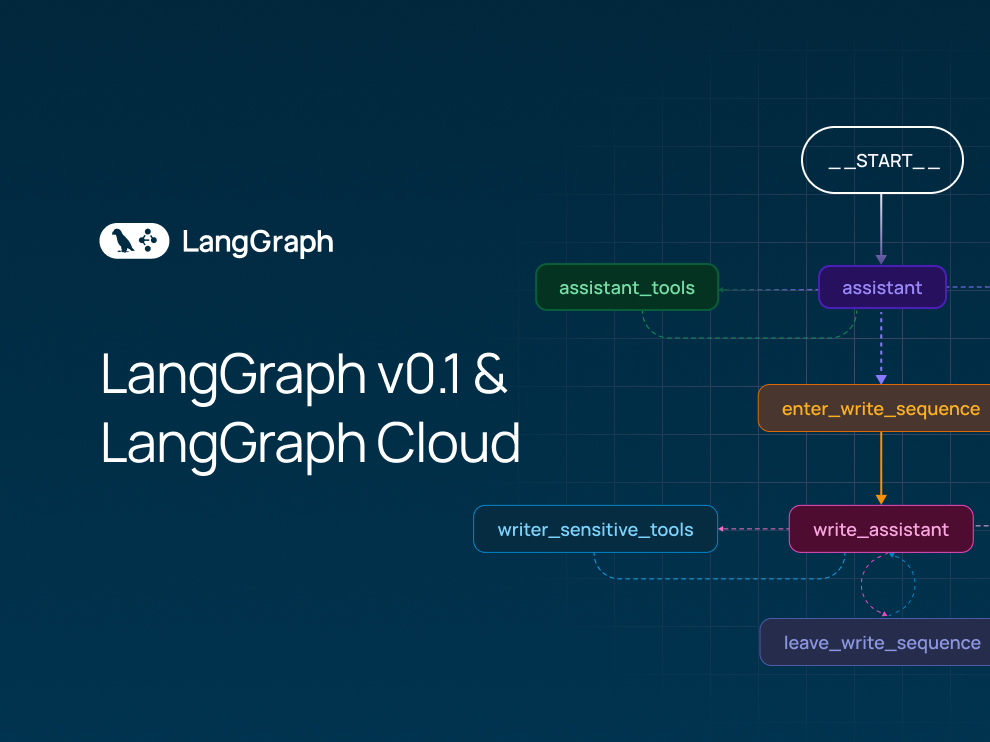
LangChain has introduced LangGraph v0.1, a framework designed to address the challenges of building reliable agentic applications. The core philosophy focuses on providing developers with precise control over agent workflows, enabling the creation of more complex and dependable systems. This contrasts with previous agentic frameworks that often hid critical details, leading to systems lacking the necessary control for real-world tasks. LangGraph achieves this through a flexible API, allowing developers to design custom cognitive architectures and manage code, prompts, and LLM calls with granular precision.
Key features of LangGraph include conditional branching, looping, and hierarchical decision patterns, supporting both single-agent and multi-agent setups. Companies like Norwegian Cruise Line and Replit are utilizing LangGraph's capabilities to build and optimize their AI solutions. Norwegian Cruise Line leverages LangGraph’s control to evaluate and optimize guest-facing AI solutions, while Replit focuses on improving the reliability of its coding agent for millions of users. The framework also incorporates moderation and quality checks to ensure agents adhere to specific conditions, preventing them from getting stuck on incorrect paths.
LangGraph facilitates human-agent collaboration through a built-in persistence layer, enabling features like explicit task waiting, action editing, and agent rewiring – often described as ‘time travel’ – for debugging and experimentation. Elastic utilizes this flexibility to build and scale AI workloads, including conversational agents and custom LLM-backed experiences. LangGraph natively supports streaming of intermediate steps and token-by-token streaming, enhancing responsiveness for long-running agentic tasks.
To complement LangGraph, LangGraph Cloud is now available in beta. This cloud-based runtime provides infrastructure specifically designed for deploying agents at scale. LangGraph Cloud manages horizontally-scaling task queues, servers, and a robust Postgres checkpointer to handle concurrent users and efficiently store large states and threads. This ensures fault-tolerant scalability and simplifies the operational aspects of running agentic applications in production.
LangGraph Cloud’s architecture is designed to address potential issues like uneven task distribution, which can lead to system overload and downtime. The platform provides a streamlined developer experience for prototyping, debugging, and monitoring agentic workflows, offering increased visibility and confidence for engineers.