Skip to content

Blog

Results for “llm”

Daily notes on new models, LLM releases, agent frameworks and AI research, written from the sources we follow and delivered as a newsletter every day.

Get the daily issue

Every new post of the day, in one email. Confirmation required.

LLMs1 min read

Dynamic Lagging Improves Simultaneous Translation with LLMs

Researchers introduced a sentence-trained LLM approach for cascaded simultaneous translation, utilizing prefix-aware fine-tuning to achieve flicker-free performance. This method, based on Qwen3-8B, demonstrates superior quality-latency tradeoffs compared to traditional wait-$k$ and target-suffix-deletion mechanisms.

From arXiv cs.CL
LLMs1 min read

CONDUIT: KV Cache Reuse Policy for VLMs

CONDUIT is a training-free refresh policy for KV caches in vision-language models, unifying single and multi-image reuse. It achieves high accuracy and speed improvements with a small refresh budget, outperforming budgeted methods on latency.

From arXiv cs.CL

LLMs1 min read

SinoGlyphBench: Benchmark Reveals Chinese Glyph Obfuscation Impact on LLMs

SinoGlyphBench, a new diagnostic benchmark, highlights the vulnerability of LLMs and MLLMs to Chinese glyph-level obfuscation. Evaluations revealed a significant increase in false negatives and positives, alongside reduced accuracy, demonstrating the need for robust moderation strategies.

From arXiv cs.CL

Research1 min read

LLMs Struggle with Second-Order Social Reasoning

Research reveals Large Language Models consistently overestimate social sanctions and misrepresent human responses to norm violations. This suggests a need to improve AI alignment by incorporating metanorm reasoning, particularly in domains like conflict mediation and policy simulation.

From arXiv cs.AI

LLMs1 min read

Neuron-Guided Fine-Tuning: Efficient Alignment for LLMs

Neuron-Guided Fine-Tuning (NGFT) offers a unified framework for LLM fine-tuning, reducing redundancy and catastrophic forgetting. Experiments across three models show significant improvements in efficiency and performance compared to existing methods.

From arXiv cs.CL

Research1 min read

LLM Agent Societies Show Value Drift in Simulations

Research simulating diverse LLM agent societies reveals significant value drift, with over 50% of personas failing to initially align with assigned WVS profiles and a 2-7% drift after conversations. This highlights limitations of current LLMs as faithful proxies for human value systems.

From arXiv cs.AI

LLMs1 min read

Document-Level MT Evaluation Shows Statistical Equivalence

Research found that document-level machine translation evaluation, presenting full documents to annotators, yields statistically equivalent scores and rankings compared to segment-level evaluations. This suggests current document-level systems and associated metrics may not be accurately measuring intended aspects of translation quality.

From arXiv cs.CL

LLMs1 min read

CLLPU Benchmark Reveals Propagation Challenges in Multilingual LLM Unlearning

A new benchmark, CLLPU, assesses multilingual LLM unlearning by evaluating the extent of knowledge suppression across languages. Experiments with Llama-3.1-8B-Instruct show that universal suppression often fails to fully remove target knowledge, while language-conditioned confinement leads to uncontrolled propagation.

From arXiv cs.CL

Research1 min read

Optimizing LLM Tool-Agent Harnesses Without Retraining

Research demonstrates improving LLM tool agents by modifying the runtime harness – prompts and middleware – without retraining. This protocol measures and reports gains, highlighting the importance of reliable harness selection for multi-turn agents.

From arXiv cs.AI

LLMs1 min read

CrisisKD: Knowledge Distillation for Aspect-Level Analysis

CrisisKD is a five-stage knowledge distillation framework using Qwen2.5-7B to perform aspect-level sentiment and emotion analysis on crisis discourse data. The open-source system improves performance and reduces inference costs compared to the teacher model.

From arXiv cs.CL

LLMs1 min read

ChatGPT Images 2.5 Released: Improved Instruction Following

OpenAI’s ChatGPT Images 2.5 models now support multi-turn instruction following, faster response times, and better subject preservation in reference images. Two new model IDs, Sunburst and Flare, are available via the API.

From Simon Willison

Agents1 min read

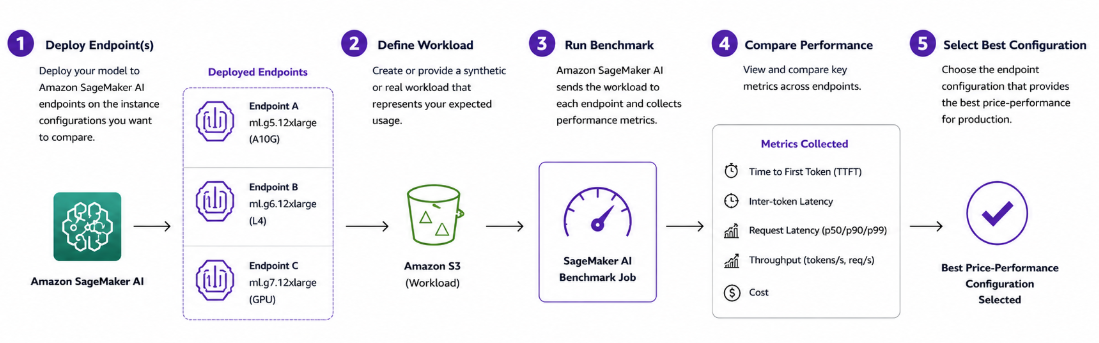
SageMaker AI: G7, G6, and G5 LLM Inference Benchmarks

This benchmark compares the performance of Qwen3-Coder-30B and NVIDIA Nemotron-3-Nano-30B across G5, G6, G6e, and G7 GPU instances on SageMaker AI. G7 instances demonstrate price-performance gains for real-time LLM inference.

From AWS machine learning blog

LLMs1 min read

Hugging Face: Topic Safety Restrictions

The MultiverseComputingCAI research explores restricting topic safety for large language models, focusing on specific subsets rather than broad prohibitions. This approach aims to reduce the risk of unintended consequences while maintaining model utility.

From Hugging Face blog

LLMs1 min read

llm 0.35

Release: llm 0.35 New OpenAI model: gpt-6-astra for GPT-6 Astra. Tags: openai, llm, gpt-6-astra

From Simon Willison

LLMs1 min read

Quoting Jakub Pachocki

The strongest argument I see for continuing to train much smarter models quickly is the need to build defensive systems against the dangers posed by other AI. [...] We will need powerful, aligned AI for defense; to secure infrastructure,...

From Simon Willison

LLMs1 min read

Mercator ↔ Equal Earth

Tool: Mercator ↔ Equal Earth I got curious about the Equal Earth map projection that was recently voted on at the UN so I had GPT-6 Astra (medium) in ChatGPT Work build me this animated transition between Mercator and Equal Earth using D...

From Simon Willison

Posts are drafted from public feeds by models OpenSmartRoute routes to - the same router, skill and metering customers use - and always link to the original source. Corrections: support.

How this blog is made

Every post is a routed request

Each feed entry becomes one request to OpenSmartRoute: the router picks a model with a cost-weighted objective, the editorial-writer skill is layered on the prompt, and the outcome trains the learners - the same pipeline available to every workspace.

Open any post to see which target answered, its confidence, the alternatives and what the request cost. Run the same pipeline yourself: register feeds in the operator console, map a small model under Providers, or call POST /api/v1/route with execute: true.