AI1 min read
Meta expands subscription push with new AI-focused plans
Meta One bundles expanded access to the company’s AI tools with premium features across Facebook, Instagram and WhatsApp.
From TechCrunch AI
Blog
Daily notes on new models, LLM releases, agent frameworks and AI research, written from the sources we follow and delivered as a newsletter every day.
Get the daily issue
Every new post of the day, in one email. Confirmation required.
AI1 min read
Meta One bundles expanded access to the company’s AI tools with premium features across Facebook, Instagram and WhatsApp.
From TechCrunch AI
Research1 min read
arXiv:2609.13356v1 Announce Type: new Abstract: In this work, we present ZGCM-1, a fully open 7B dense foundation model trained from scratch with extreme data, system, and algorithmic efficiency. ZGCM-1 is founded on a core premise: comp...
From arXiv cs.AI
LLMs1 min read
arXiv:2609.13154v1 Announce Type: new Abstract: Recent advances in large language models (LLMs) have made prompts increasingly large and complex. Techniques such as chain-of-thought reasoning (Wei et al., 2022) and in-context learning (B...
From arXiv cs.CL
LLMs1 min read
arXiv:2609.13745v1 Announce Type: new Abstract: Vision--language models (VLMs) can answer chart questions accurately, but output accuracy does not show how they combine the evidence needed to recover an exact value. We study vertical-bar...
From arXiv cs.CL
Research1 min read
arXiv:2609.13475v1 Announce Type: new Abstract: Existing pipelines for clinical timeline extraction from case reports are evaluated using an expert reference and are limited by imperfect reference annotations and imprecise event alignmen...
From arXiv cs.AI
Research1 min read
arXiv:2609.13580v1 Announce Type: new Abstract: Large language models (LLMs) have demonstrated strong capabilities across a wide range of natural language processing tasks. However, conventional fine-tuning typically relies on centralize...
From arXiv cs.AI
Research1 min read
arXiv:2609.13579v1 Announce Type: new Abstract: Safety research often focuses on model-generated harms, but users may also direct hostility, coercion, and adversarial pressure at models. Understanding how and when that occurs is essentia...
From arXiv cs.AI
Research1 min read
arXiv:2609.13491v1 Announce Type: new Abstract: The strong performance of AI Agents across an impressive variety of tasks is driving an unprecedented investment in agentic infrastructures, however the cost of processing tokens is fast in...
From arXiv cs.AI
LLMs1 min read
arXiv:2609.13151v1 Announce Type: new Abstract: Leading multilingual speech recognition models like Whisper transcribe diverse, low-resource languages without language-specific training but are computationally expensive to deploy. Token ...
From arXiv cs.CL
LLMs1 min read
Federated learning (FL) projects often begin with a straightforward setup: one server, a few clients, and one dataset at each site. As those projects grow, the...
From NVIDIA technical blog
Models1 min read
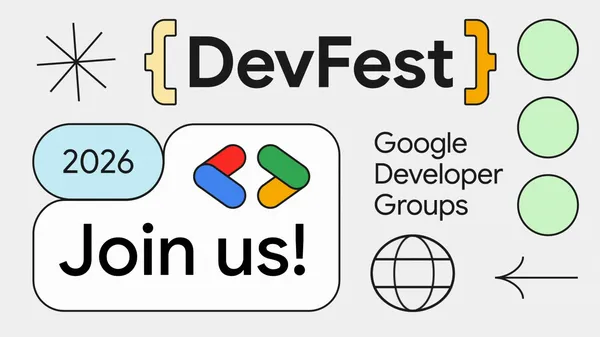
DevFest 2026, running from October 1 – December 31, 2026, offers nearly a million developers hands-on experience with Google’s AI technologies across a global network of events. The program focuses on building, securing, and scaling in the agentic era.
From Google AI blog
AI1 min read
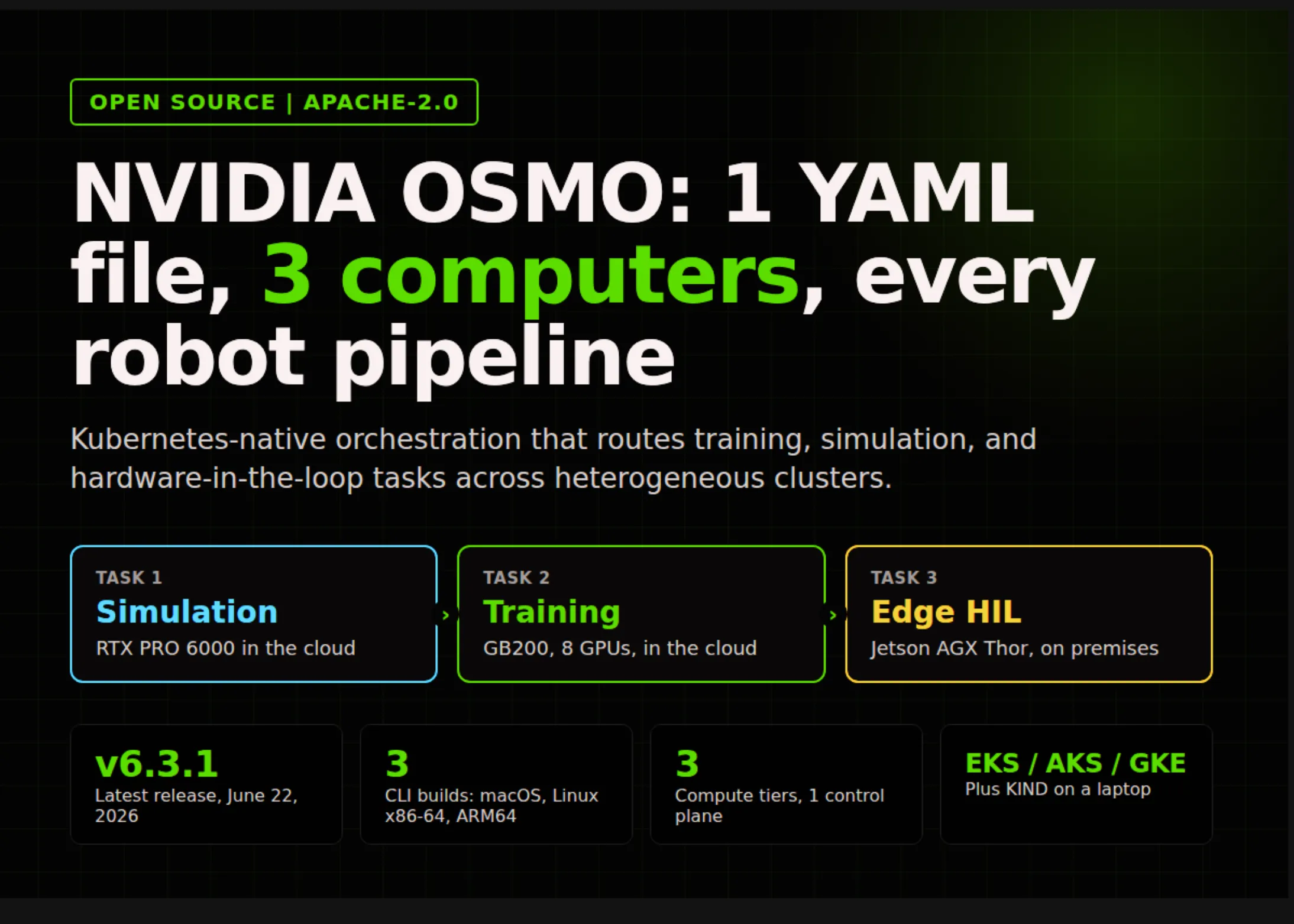
OSMO is an open-source Kubernetes orchestrator that allows engineers to manage AI training, simulation, and robot testing across diverse compute environments – from data center GPUs to edge devices – defined by a single YAML file. This simplifies pipeline management and reduces infrastructure complexity.
From MarkTechPost
LLMs1 min read
The ORQA framework provides a method for testing large language model knowledge across 116 occupations using data sourced from trusted occupation-specific websites. Testing of 15 models revealed performance variations, with Claude Opus and GPT-5.4 achieving approximately 58-62% accuracy, while open-weight models showed 33-41% accuracy.
From arXiv cs.CL
LLMs2 min read
SynthSentry is a model-agnostic tool for detecting synthetic data contamination in language model training corpora. It analyzes lexical diversity, n-gram tails, and perplexity variance across reference models, offering a pre-training screening method without requiring access to the generating model.
From arXiv cs.CL
Research1 min read
A new Latent-Attention Masked Autoencoder (LAMAE) was developed for learning patient-level representations from multimodal cardiac data. Pretrained on MIMIC-IV, LAMAE outperforms modality-specific models and achieves improved performance across multiple clinical tasks, even with single-modality inputs.
From arXiv cs.AI
LLMs1 min read
The ESTS team achieved parameter counts between 4.186B and 7.770B and artifact sizes between 4.55 and 6.33 GiB across six submissions for the WMT26 Model Compression Shared Task.
From arXiv cs.CL
LLMs1 min read
Researchers developed a scalable method using acoustic masking to quantify the contribution of individual consonants to word intelligibility. The study, employing ASR models across English, Spanish, German, and Czech, identified phoneme frequency and functional load as key factors influencing consonant disruption rates.
From arXiv cs.CL
LLMs1 min read
The research introduces Chopthin-Consensus Power Sampling (CCPS), a method for LLM decoding that preserves reasoning diversity and improves accuracy. Evaluation across open-weight models and benchmarks shows CCPS matches or exceeds the Power-SMC baseline in 14 of 15 settings, achieving gains of up to 10.6 percentage points.
From arXiv cs.CL
LLMs1 min read
A human annotation process was completed on 100 Quran recitation recordings, identifying and labeling errors, repetitions, and spelling differences. Initial pilot testing with multiple models and agents yielded varying F1 scores, highlighting the importance of careful annotation interfaces and normalization steps.
From arXiv cs.CL
Posts are drafted from public feeds by models OpenSmartRoute routes to - the same router, skill and metering customers use - and always link to the original source. Corrections: support.
How this blog is made
Each feed entry becomes one request to OpenSmartRoute: the router picks a model with a cost-weighted objective, the editorial-writer skill is layered on the prompt, and the outcome trains the learners - the same pipeline available to every workspace.
Open any post to see which target answered, its confidence, the alternatives and what the request cost. Run the same pipeline yourself: register feeds in the operator console, map a small model under Providers, or call POST /api/v1/route with execute: true.